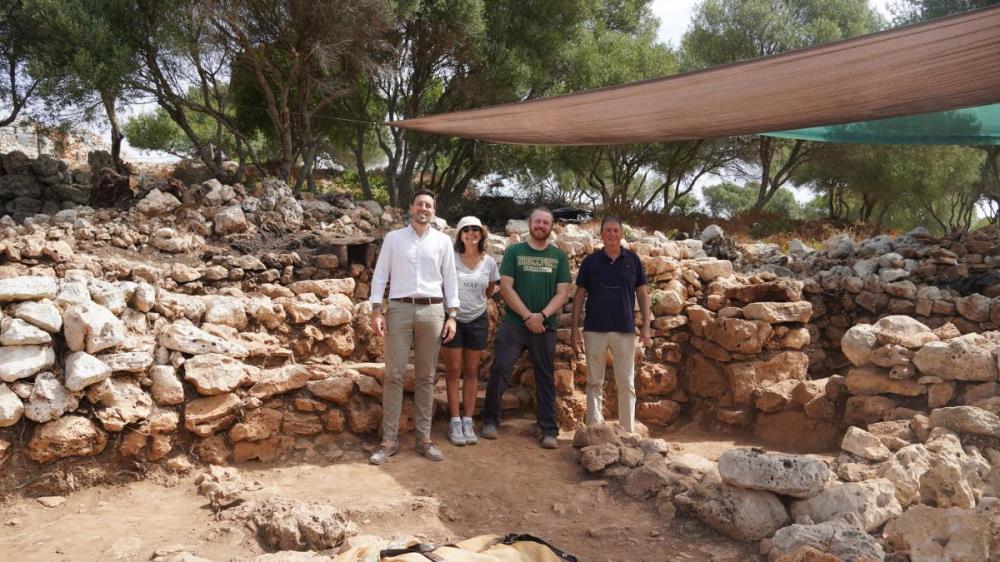
This summer’s archaeological campaign at Torre d’en Galmés has uncovered an exceptionally well-preserved Andalusi rural house dating to the 12th and 13th centuries. The discovery establishes the site as one of the most significant archaeological references for the study of Islamic rural domestic architecture in the Balearic Islands.
The excavation forms part of the
Menorca Archaeological Project (MAP), an international research programme directed by Amalia Pérez-Juez (Boston University) and Alexander J. Smith (SUNY Brockport). The project is carried out in collaboration with the Consell Insular de Menorca, ASOR (The American Society of Overseas Research), and the European research project MEDGREENREV, funded through the ERC Synergy Grant 2022, together with the support of several national and international institutions. Additional collaboration is provided by Alaior Town Council, IES Josep Miquel Guàrdia and the Association of Volunteers for Paths and Archaeological Sites.
The results of the excavation campaign were presented on Wednesday, 15 July, by the project directors, together with Joan Pons, Councillor for Culture, Youth, Education and Sports of the Consell Insular de Menorca, and Nando Orfila, Councillor of Alaior Town Council.
Excavation has continued within a large domestic complex arranged around a spacious central courtyard, following the characteristic layout of rural farmsteads in al-Andalus. The remarkable state of preservation has allowed archaeologists to document the building’s internal organisation in exceptional detail, as well as the construction techniques employed by its inhabitants.
The house preserves a range of clearly defined domestic spaces, including living areas, kitchens and storage rooms. Among the most significant discoveries are original floor surfaces, walls retaining their lime plaster, and the complete collapse of the roof, represented by thousands of ceramic roof-tile fragments. Together, these remains make it possible to reconstruct the original appearance of the building and its interior spaces with remarkable accuracy.
The excavation has also produced a rich assemblage of archaeological finds, including pottery used for storage, cooking and tableware, together with metal objects associated with everyday activities such as spinning wool and other fibres. One particularly notable discovery is an iron fitting, probably belonging to a wooden chest. These finds provide valuable new evidence for understanding the daily lives of the last Andalusi inhabitants of Torre d’en Galmés.
Research carried out through the Menorca Archaeological Project continues to demonstrate that Torre d’en Galmés was not only one of the island’s largest Talayotic settlements but also remained an important centre throughout the medieval period. An Andalusi alqueria developed among the prehistoric structures, where existing buildings were adapted for new uses while preserving much of the earlier architectural landscape.
This uninterrupted sequence of occupation, spanning more than two millennia, makes Torre d’en Galmés an exceptional archaeological site for exploring the long-term evolution of a continuously inhabited landscape, from prehistory to the end of the medieval period.
The project also employs a wide range of advanced archaeological methods, including micromorphology, geoarchaeology, archaeobotany, zooarchaeology, charcoal and phytolith analysis, alongside 3D recording and digital photogrammetry. These approaches provide detailed insights into construction techniques, site formation processes and the ways in which different spaces were used.
Laboratory analysis and specialist study of the recovered material will continue over the coming months. The results will contribute to future scientific publications, support the virtual reconstruction of the Andalusi alqueria, and further our understanding of the long-term history of Torre d’en Galmés.