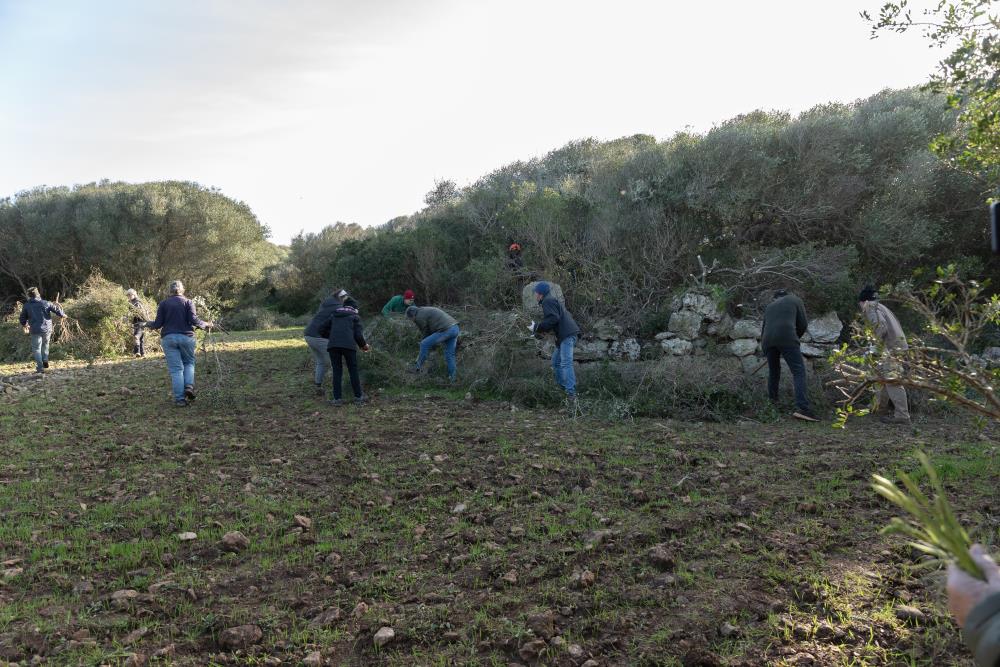
The initiative has revealed monumental structures that, until now, were only known through archaeological mapping carried out in the 1970s by Mascaró Pasarius
Since 2025, the Volunteer Group for the Protection of Ethnological Heritage (GIBET), part of the Martí i Bella Historical and Archaeological Society, has been leading a project to recover and enhance the archaeological site of Torrevella d’en Lozano in Ciutadella, Menorca. For decades, the site remained almost entirely hidden beneath dense vegetation, limiting both its visibility and its archaeological interpretation.
Thanks to the ongoing commitment of volunteers, this important prehistoric settlement is gradually re-emerging within the island’s cultural landscape, allowing its archaeological significance to be appreciated once again.
On one Sunday each month, volunteers gather to carry out clearance and maintenance work aimed at improving access to the site and safeguarding its archaeological remains.
From historical maps to archaeological reality
Before these efforts began, knowledge of Torrevella d’en Lozano was largely based on historical documentation. The most significant reference was the Archaeological Map of Ciutadella, published in 1971 by archaeologist and cartographer J. Mascaró Pasarius together with Magda Marroquín. Their work described a site of considerable importance, including seven talayots, although much of it was already obscured by vegetation at the time.
The work undertaken by GIBET is now bringing these remains back into view. An initial phase focused on the Torrenova d’en Lozano estate, where volunteers successfully cleared and recovered one of the talayots. More recently, efforts have shifted to the neighbouring Torrevella property, concentrating on the taula enclosure and the adjacent talayot.
According to GIBET, the project is making an important contribution both to heritage preservation and archaeological knowledge: “Our work helps recover part of Menorca’s shared history while providing new information about a site that remains largely unexplored.”
The project is supported by the Island Council of Menorca through the Talayotic Menorca Agency, as part of its commitment to the conservation, research and public dissemination of the island’s archaeological heritage.
Activities will pause during the summer months and resume once temperatures become more favourable. The long-term goal is to continue protecting and enhancing this valuable archaeological heritage for future generations.