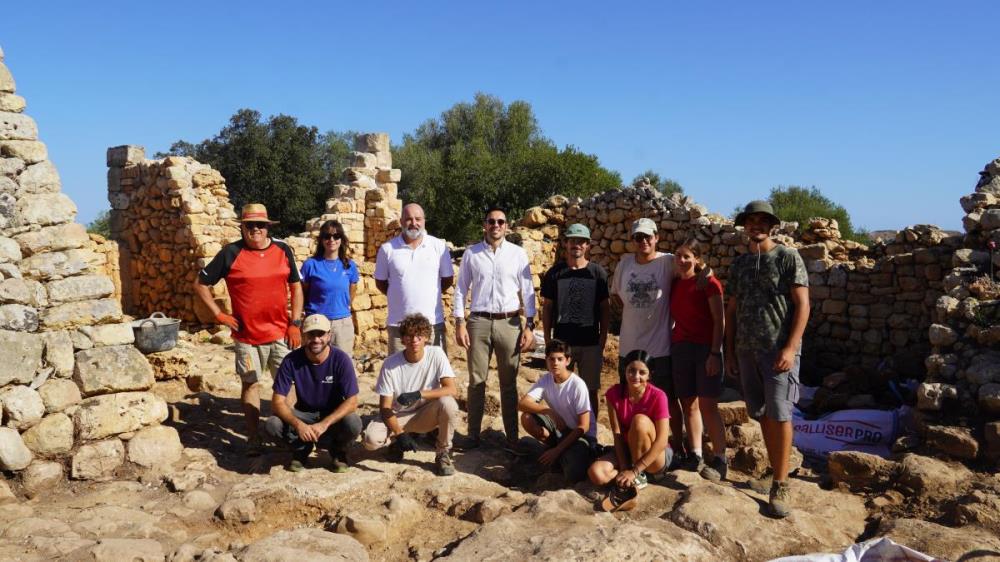
 The fifth excavation and restoration campaign has revealed new rooms, floors and artefacts from a unique late medieval and Baroque rural dwelling in Menorca
Since the 1980s, the Fundació Illes Balears has been committed to preserving and promoting the cultural heritage of the Balearic Islands. One of its most important sites is the archaeological complex of Torralba d’en Salort, where a new research and conservation project was launched in 2022 to investigate a historic building that, until just a few years ago, lay largely hidden beneath vegetation on the western edge of the estate.
For decades, the only visible clue to its existence was a striking doorway flanked by two small chapels bearing incised Latin crosses. Despite standing within one of Menorca’s best-known archaeological sites, the building had received little attention from researchers. Local memory, however, had kept its existence alive: farmers in the area traditionally referred to it as ses antigues cases de Torralba — “the old houses of Torralba”.
Today, a team of archaeologists, conservators and historians working with Amics del Museu de Menorca is piecing together the history of the building through archaeological excavation, the study of recovered artefacts and research into historical records preserved in archives.
The 2026 campaign, which began on 17 August, marks the fifth consecutive season of fieldwork at the site. The latest findings were presented on Thursday, 3 September, by the project leaders, together with Menorca’s Councillor for Culture, Youth, Education and Sport, Joan Pons, and Rafa Durán, representing the company that manages Torralba d’en Salort and the Fundació Illes Balears.
The project is co-directed by Carlos de Salort and Francesc Isbert, with a technical team made up of archaeologists, conservators and specialists from a range of disciplines. This year, around ten students and volunteers from Menorca and universities across Spain also took part in the excavation.
An almost 300-square-metre building hidden from view
The first campaign, carried out in August 2022, cleared the area of vegetation and brought to light an architectural complex measuring approximately 300 square metres. Much of it had been concealed beneath later dry-stone structures and substantial deposits of rubble.
From the outset, the building’s architectural features pointed to its origins as a rural dwelling: stone-and-lime mortar walls, sandstone (marès) arches and vaults, traditional Arabic roof tiles, lime-rendered surfaces and floors, among other features typical of Menorcan domestic architecture.
This year’s campaign has continued to expose and excavate new rooms, paved areas, walls and successive building phases, shedding further light on a structure whose origins are thought to date back to the 15th or 16th century. At the same time, conservation work is being carried out to stabilise and protect the structures as they emerge from the ground.
Pottery, tools, coins and traces of everyday life
The artefacts recovered during the successive campaigns offer a glimpse into the daily lives of the people who lived here between three and five centuries ago.
The finds include pottery dating from the 16th, 17th and 18th centuries, both locally made and imported, as well as tools and objects associated with farming and domestic activities, keys, horseshoes and other metal artefacts.
Some finds offer particularly revealing insights into everyday life and social practices. These include smoking pipes, gaming pieces and a range of objects connected with religious beliefs and practices. Taken together, the material evidence is beginning to establish not only the chronology of the building, but also the habits, economic activities and more private aspects of the lives of its former occupants.
From medieval settlers to modern-day Menorca
One of the project’s most distinctive features is the way archaeological evidence is being combined with documentary research. Historical records — including capbreus, llibres de fadigues, notarial records and other documents — are helping researchers trace the history of the Torralba estate and connect it with some of the families who settled in Menorca following the Christian conquest of 1287.
Among the names found in the records are the Gonyalons, Marquès, Villalonga and Cardona families, several of whose surnames remain firmly rooted in Menorcan society today.
Archaeological and documentary evidence indicates that the building underwent numerous alterations over the centuries and probably ceased to serve as a permanent home during the 17th century. Some areas may subsequently have been adapted for other purposes. One of the possibilities now being explored is a religious use, suggested both by the unusual entrance flanked by two small chapels and by the significant number of objects associated with religion, belief and symbolic practices recovered at the site.
A unique excavation offering new insights into rural Menorca from the Middle Ages to the present day
The excavation of the old Torralba houses is an especially significant project in Menorca, where archaeological investigations of rural domestic architecture dating from the late medieval and early modern periods are relatively rare.
The research looks beyond the prehistoric monumental heritage for which Torralba d’en Salort is internationally renowned, offering a window onto a much more recent period that is nevertheless essential to understanding how Menorca’s rural landscape took shape.
The ultimate aim is to reconstruct the development of the settlement through archaeological evidence and, in doing so, gain a deeper understanding of the processes of resettlement, land occupation and the formation of rural Menorcan society following 1287.
Next step: reopening the enigmatic doorway
Work will continue over the coming weeks. One of the most anticipated stages will be the controlled archaeological removal of the wall currently blocking the old doorway. This will allow the team to examine the entrance in detail and better understand how it relates to the building’s successive phases of development.
The intervention will also mark an important step towards restoring the historic entrance to this late medieval and early modern complex, gradually bringing back to life a part of Torralba d’en Salort that had remained hidden — and largely forgotten — for generations.