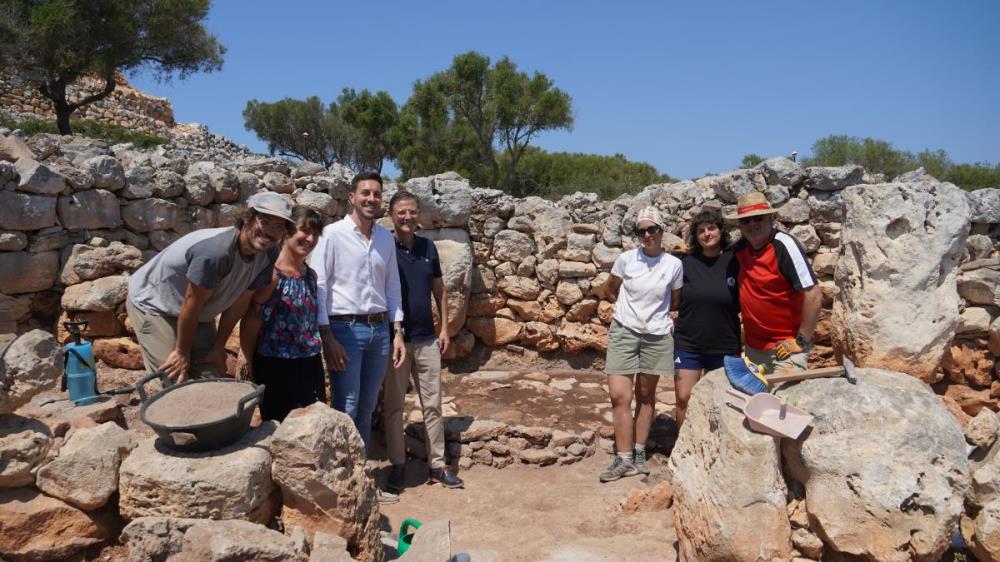
 This year’s campaign combined excavation, conservation and training, with the participation of university students and volunteers from Menorca and across Spain
The archaeological excavations at Torre d’en Galmés have concluded another successful field season, marked by significant advances in the research and conservation of the so-called Structure 1, one of the oldest dwellings in the Talayotic settlement.
During this year’s campaign, the floors of three rooms within the dwelling were carefully lifted in order to document the underlying archaeological layers, study the building’s development over time, and subsequently restore these spaces so they can be opened to visitors.
One of the campaign’s most significant discoveries was the excavation of a new human skeleton, the seventh to be documented within this same structure. This finding strengthens the hypothesis that the dwelling was abandoned under exceptional circumstances, as the presence of human remains inside a domestic space is highly unusual for this historical period.
The excavation took place between 22 June and 5 July, coinciding with a field school for university students. Six students from Madrid, Andalusia and Catalonia took part, alongside around ten volunteers and young students from Menorca, combining practical training with archaeological research. One of the most important discoveries made during the first days of excavation was a decorated carinated Talayotic pot, intentionally deposited beneath the floor of one of the rooms. Its location, within a sealed context below the dwelling’s occupation surface, suggests that its deposition may have formed part of a symbolic or ritual practice.
From 6 to 10 July, the team focused on the final stages of conservation and restoration of the excavated areas, with the aim of ensuring their long-term preservation and preparing them for future public access. The next phases of the project will focus on two main objectives: the anthropological study of the human remains recovered throughout the different excavation seasons, and the consolidation and reconstruction of the structure’s walls, pillars and floors.
The results of this year’s campaign will be presented during an Open Day to be held this Thursday at 7:00 p.m. at the Torre d’en Galmés archaeological site. During the visit, the project directors will guide participants through the excavation area, presenting the campaign’s principal discoveries and explaining the progress of this summer’s work.
This project is made possible through the financial support of the Consell Insular de Menorca, Alaior Town Council, and the members of the Friends of the Museum of Menorca Association. It also receives scientific support from Boston University, the Royal Institute for Cultural Heritage (Belgium), the Escola Superior de Conservació i Restauració de Béns Culturals de Catalunya, and the surveying company TANIT SL. Additional collaborators include Maó Town Council, the Fundació Foment del Turisme de Menorca, the Museum of Menorca, INJUVE, Menorca Foto, Menjars Preparats La Paella, and Rótulos Ornaque.