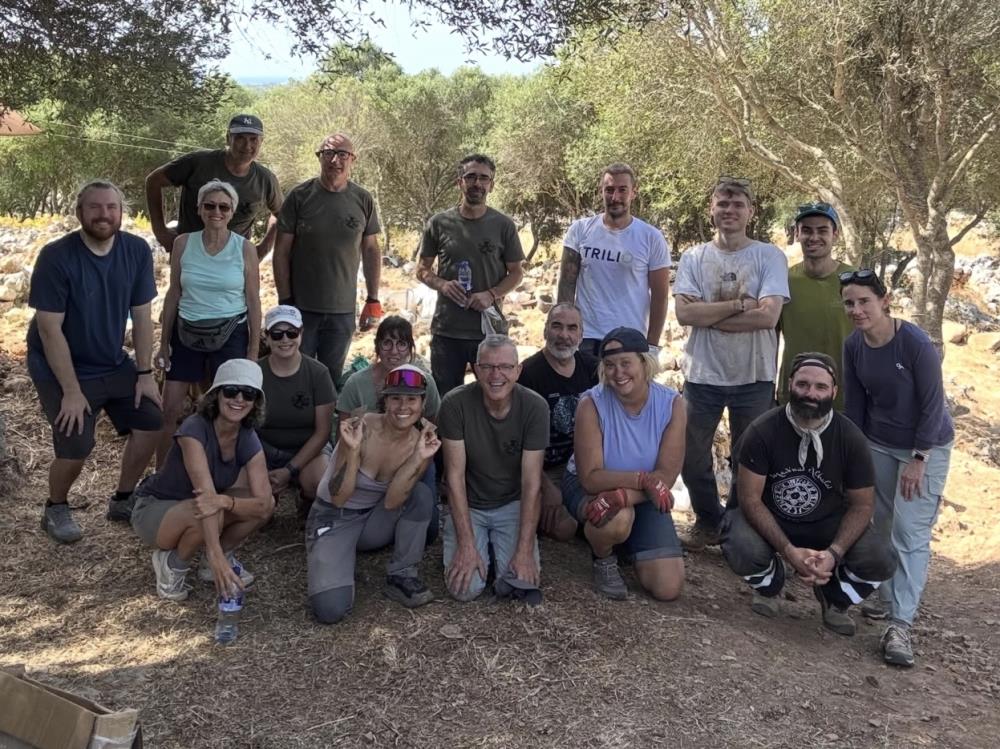
The 2026 excavation season of the
Menorca Archaeological Project (MAP) at Torre d'en Galmés has culminated in the excavation of a remarkable Andalusi rural house dating to the 12th–13th centuries. The discovery places the site among the most significant archaeological references for the study of medieval rural domestic architecture in the Balearic Islands.
The building is exceptionally well preserved, allowing archaeologists to document its internal layout and construction techniques in extraordinary detail. The excavation has also yielded a rich assemblage of archaeological finds, including ceramic vessels used for storage, cooking and tableware, metal objects associated with wool and fibre spinning, and iron fittings that may have belonged to a wooden chest. Together, these discoveries provide valuable insight into the daily lives of the community that inhabited Torre d'en Galmés during the final decades of Islamic Menorca.
For decades, Torre d'en Galmés has been known primarily for its impressive Talayotic monuments. Research carried out by the Menorca Archaeological Project is now demonstrating that the site remained an important settlement throughout the medieval period, when a thriving Andalusi farmstead was established among the prehistoric structures. Rather than replacing the earlier landscape, its inhabitants adapted and reused the ancient buildings, creating a settlement that remained closely connected to the surrounding agricultural environment.
This continuity of occupation, spanning more than 2,000 years, makes Torre d'en Galmés an exceptional place for studying the long-term evolution of a continuously inhabited landscape from Prehistory through to the end of the Middle Ages. It also highlights one of the outstanding values of Talayotic Menorca, recognised as a UNESCO World Heritage property.
The project combines traditional excavation with some of the most advanced archaeological techniques currently available, including micromorphology, geoarchaeology, archaeobotany, zooarchaeology, charcoal and phytolith analysis, digital photogrammetry and 3D recording. These methods are helping researchers reconstruct not only how the buildings were constructed, but also how each space was used.
Laboratory analysis and the study of the recovered materials will continue over the coming months. The results will contribute to future scientific publications and to the virtual reconstruction of the Andalusi settlement and the historical development of Torre d'en Galmés.
Open Day: 12 July
To share the results of this year's excavation with the public, the Menorca Archaeological Project will host an Open Day on Sunday, 12 July, at 6:30 pm, at Torre d'en Galmés. Members of the research team will present the main discoveries from the fourth excavation season and explain the significance of the findings.
The excavation is co-directed by Amalia Pérez-Juez (Boston University) and Alexander J. Smith (SUNY Brockport) as part of an international research project investigating the medieval occupation of Torre d'en Galmés since 2019. The project is carried out in collaboration with the Talayotic Menorca Agency, through the Island Council of Menorca, ASOR (The American Society of Overseas Research), and the European research project MEDGREENREV: Re-thinking the Green Revolution in the Medieval Western Mediterranean (6th–16th centuries), funded by the ERC Synergy Grant 2022 (ERC-2022-SYG), together with a number of national and international research institutions.
Images: Menorca Archaeological Project